
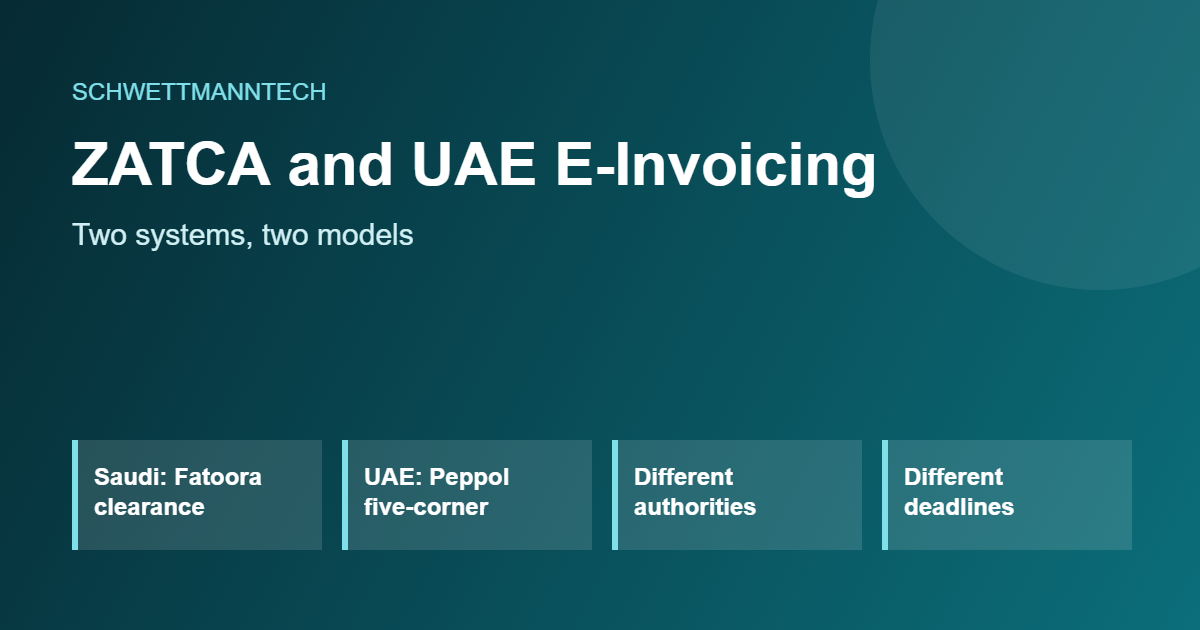
ZATCA and UAE e-invoicing are two separate systems run by two different governments, and treating them as one is a costly mistake. ZATCA is Saudi Arabia’s Zakat, Tax and Customs Authority. The UAE has its own e-invoicing framework, set by the Ministry of Finance and the Federal Tax Authority (FTA). If you invoice customers in both countries, you will probably need to comply with both, using different technology and different deadlines.
This guide explains which rules apply to your business, the key dates as of November 2026, how the two models differ, and how to prepare your ERP. It is written for finance and IT teams in the UAE, Saudi Arabia and the wider GCC.
ZATCA and UAE e-invoicing at a glance
| Item | Saudi Arabia (ZATCA) | United Arab Emirates |
|---|---|---|
| Authority | Zakat, Tax and Customs Authority (ZATCA) | Ministry of Finance and Federal Tax Authority (FTA) |
| Model | Fatoora platform with clearance and reporting, in two phases | Decentralised five-corner model on the Peppol network |
| How you connect | Your system integrates directly with ZATCA’s Fatoora platform in Phase 2 | Through an Accredited Service Provider (ASP) approved by the Ministry of Finance |
| Invoice format | Structured XML with a QR code and a cryptographic stamp | PINT AE structured XML |
| Who is in scope | Taxpayers resident in Saudi Arabia, in turnover-based waves | In-scope businesses for B2B and B2G invoices, split by an AED 50 million revenue threshold |
| Status | Phase 2 rolling out in waves since 1 January 2023; Wave 25 integration deadline is 1 February 2027 | Pilot from 1 July 2026; mandatory from 1 January 2027 for the first group |
Does ZATCA apply to businesses in the UAE?
No, not by default. ZATCA’s e-invoicing regulations apply to taxpayers resident in Saudi Arabia. A company registered only in the UAE is covered by the UAE framework, not by ZATCA.
The picture changes if you also operate in Saudi Arabia. A Saudi branch, subsidiary or VAT-registered entity must follow ZATCA’s rules for its own invoices, while your UAE entity follows the UAE rules. Each legal entity is assessed separately, so group finance teams should map every entity to its country and phase. For cross-border structures, confirm the treatment with a tax adviser.
UAE e-invoicing timeline: key dates
The UAE framework rests on Ministerial Decisions No. 243 and No. 244 of 2025. Ministerial Decision No. 66 of 2026 moved the first appointment deadline. The mandate is phased by annual revenue:
- 1 July 2026: pilot and voluntary adoption begin.
- 30 October 2026: deadline to appoint an Accredited Service Provider (ASP) for businesses with annual revenue of AED 50 million or more, extended from 31 July 2026.
- 1 January 2027: e-invoicing becomes mandatory for that group.
- 31 March 2027: ASP appointment deadline for businesses below AED 50 million and for government entities.
- 1 July 2027: e-invoicing becomes mandatory for businesses below AED 50 million.
- 1 October 2027: e-invoicing becomes mandatory for government entities.
Because it is now late November 2026, the first appointment deadline has passed. Large businesses that have not yet appointed an ASP should do so immediately and check the Ministry of Finance website for updates. Published summaries differ on whether the first group is “AED 50 million or more” or “exceeding AED 50 million”, so check the wording of the decision if your revenue is close to the line.
The mandate currently covers business-to-business (B2B) and business-to-government (B2G) transactions. Business-to-consumer (B2C) receipts are outside scope for now.
How UAE e-invoicing works: the five-corner model
The UAE uses a decentralised model built on the Peppol network. You do not send invoices to the FTA yourself. Five parties take part:
- Supplier: your ERP creates a structured invoice, not a PDF.
- Supplier’s ASP: validates the invoice against the UAE format, PINT AE, and sends it over Peppol.
- Buyer’s ASP: receives and verifies the invoice.
- Buyer: receives the structured data in their finance system.
- Tax authority: the FTA receives the tax data reported through the service providers.
An ASP is a provider accredited by the Ministry of Finance. Choosing one is the main decision for UAE businesses, because your ERP has to connect to it.
ZATCA e-invoicing in Saudi Arabia: Phase 1 and Phase 2
Saudi Arabia’s Fatoora programme runs in two phases, and Phase 2 is still rolling out in waves.
- Phase 1, generation: from December 2021, invoices must be generated and stored electronically with the required fields, including a QR code.
- Phase 2, integration: from 1 January 2023, taxpayers connect their systems to ZATCA’s Fatoora platform. B2B invoices are cleared by ZATCA before they are issued to the customer, and B2C invoices are reported within 24 hours.
Phase 2 applies in waves based on VAT-subject revenue, and ZATCA notifies each wave at least six months before its deadline. Wave 24 covered taxpayers above SAR 375,000 in 2022, 2023 or 2024, with a deadline of 30 June 2026. Wave 25 covers taxpayers above SAR 187,500 in 2022, 2023, 2024 or 2025, who must integrate by 1 February 2027. Check your own ZATCA notification for your exact date.
What to do if you operate in both countries
- List every legal entity with its country, tax registration and revenue band.
- For each Saudi entity, confirm its wave and integration date in your ZATCA notification.
- For each UAE entity, confirm its phase against the AED 50 million threshold and appoint an ASP.
- Keep customer and supplier master data clean: tax numbers, addresses and electronic endpoints must be complete.
- Test sample invoices and credit notes before each go-live date.
- Name one owner for each system so that no deadline is missed.
How to prepare your ERP for ZATCA and UAE e-invoicing
Both systems need your ERP to produce clean, structured invoice data. The format and the connection differ, but the preparation overlaps:
- Tax setup: VAT codes, rates and exemptions must match how each authority expects them to be reported.
- Master data: complete tax registration numbers and addresses for every customer.
- Invoice numbering and credit notes: make sure sequences, and the links between invoices and credit notes, are reliable.
- Connectivity: ask your ERP vendor or implementation partner which connector or export your ASP supports in the UAE, and how the Fatoora integration is handled in Saudi Arabia.
- Testing: run sample invoices through the provider’s test environment before go-live.
If you run Dynamics 365, the right approach depends on the module and version. Book a free consultation to review how your ERP will connect to an ASP and to Fatoora.
Key takeaways on ZATCA and UAE e-invoicing
- ZATCA and UAE e-invoicing are separate regimes: Saudi Arabia uses central clearance through Fatoora, while the UAE uses accredited service providers on the Peppol network.
- Businesses operating in both countries must treat ZATCA and UAE e-invoicing as two compliance projects with their own deadlines.
- Your ERP needs clean, structured invoice data to meet ZATCA and UAE e-invoicing requirements, whichever connection route you use.
- Check your own wave or phase date early, because each entity is assessed separately.
Frequently asked questions
Is ZATCA e-invoicing required in the UAE?
No. ZATCA is Saudi Arabia’s authority, and its e-invoicing rules apply to taxpayers resident in Saudi Arabia. UAE businesses follow the UAE framework. If you have a Saudi entity, that entity must follow ZATCA.
Is e-invoicing mandatory in the UAE?
Yes, in phases. It becomes mandatory on 1 January 2027 for businesses with annual revenue of AED 50 million or more, on 1 July 2027 for smaller in-scope businesses, and on 1 October 2027 for government entities.
Do UAE e-invoices go directly to the FTA?
No. The supplier’s ASP validates the invoice and sends it over the Peppol network, and the tax data is reported to the FTA through the service providers. You do not send XML files to the authority yourself.
What is the difference between Fatoora and the UAE model?
Saudi Arabia’s Fatoora is a centralised model: your system connects to ZATCA, which clears B2B invoices before they are issued. The UAE uses a decentralised five-corner Peppol model in which accredited providers exchange the invoices.
What happens if I miss a deadline?
Both countries impose penalties for non-compliance. In the UAE, published summaries describe monthly administrative penalties until the business complies. Amounts are set in the official decisions, so check the current schedule with the authority.
Official sources
Rules in both countries were amended during 2026, so confirm current dates before you act. Primary sources: ZATCA’s announcement of the 25th wave, the UAE Ministry of Finance Electronic Invoicing Guidelines and the Federal Tax Authority. This article is general information, not tax advice.
Frequently asked questions about ZATCA and UAE e-invoicing
Are ZATCA and UAE e-invoicing the same?
No. ZATCA applies to Saudi Arabia, while UAE businesses follow a separate federal e-invoicing framework. A regional solution should keep country-specific compliance rules separate.
Can one connector support both Saudi Arabia and the UAE?
One integration layer can support both markets when it uses separate country-specific validation, transmission, and exception-handling adapters.
Which systems should an e-invoicing integration connect?
The solution may need to connect ERP, POS, CRM, e-commerce, billing, customer master data, and finance workflows so invoice data remains consistent from creation through archiving.
What should businesses test before going live?
Test structured invoice data, tax calculations, validation failures, rejected documents, duplicate invoices, service outages, retries, credit notes, cancellations, and the complete audit trail.
